
Is your table worth retrofitting?
Not every older plasma table deserves a fresh control package. Before money goes into controllers, height control and software, the steelwork and motion need a hard look.
Assess the iron and the screen
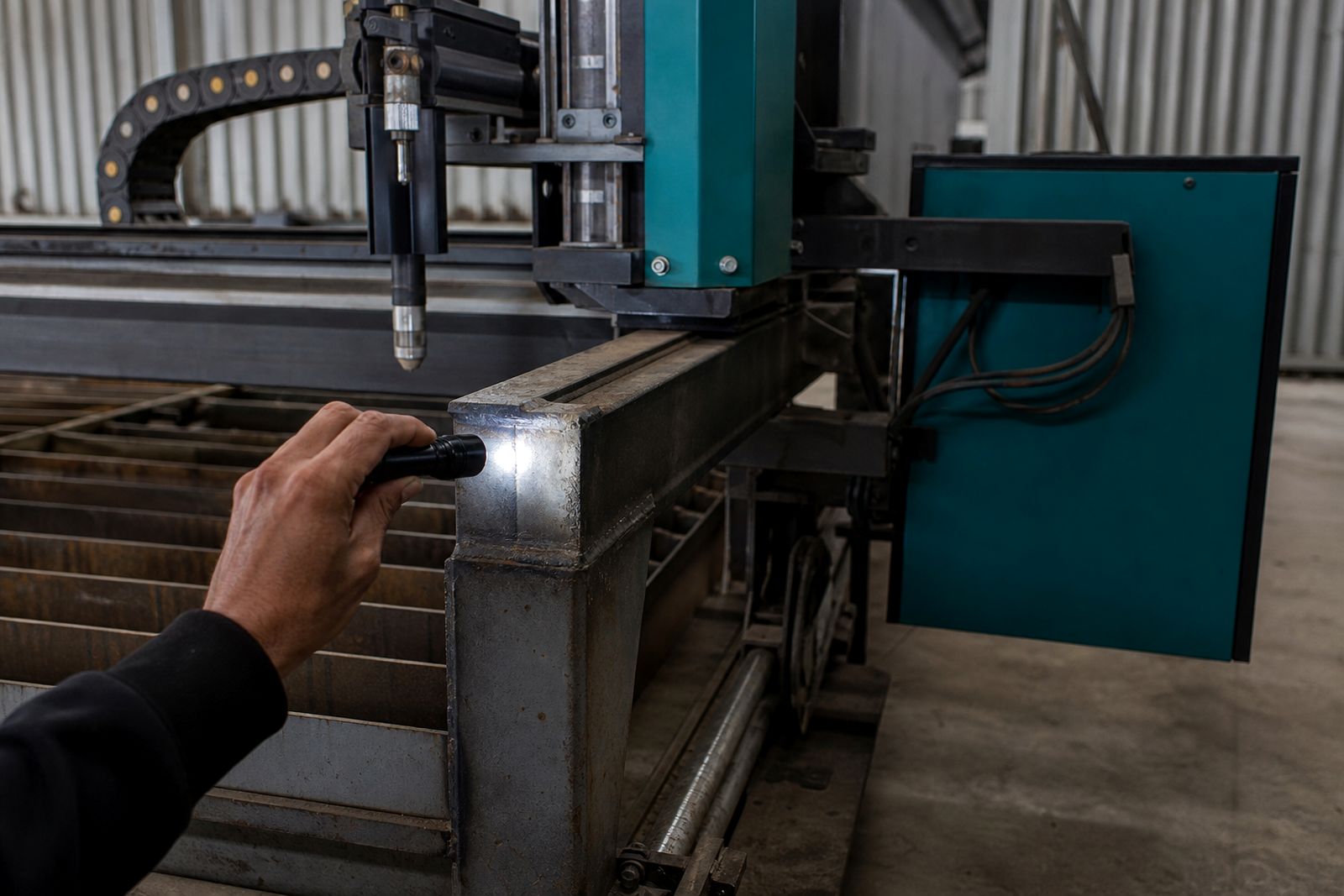
Table alignment under daily cutting loads is the first point to settle. A retrofit can transform motion, arc control and cut quality, but it cannot hide a twisted frame, a sagging slat bed or rails that have worn into a shallow wave. If the mechanical base is poor, new electronics simply make bad movement more accurate.
On site we usually begin with the main frame, gantry straightness and bed support members. Older coastal tables around Gqeberha often show corrosion where water trays, slat holders and cross members trap moisture. Inland tables may look cleaner yet still have fatigue around welded leg sets and rail mounts. A table can look serviceable from three metres away and still be too far gone once you put a straightedge and dial indicator on it.
- Check for frame twist from corner to corner.
- Look at rail mounting faces for pitting, shims stacked badly or cracked welds.
- Inspect the slat bed supports for burn-through and sagging.
- Confirm the gantry has not been bent by collisions or poor lifting.
- Note corrosion around water pans, drain points and cable entry holes.
Rail wear tells the truth quickly
If you want one honest mechanical clue, inspect the rails and bearing paths. Controls can be replaced. Rails, racks and linear guide mounting surfaces decide whether the table can repeat position cleanly over a full sheet. When the torch tracks well near home but loses line farther out, rail wear or a mounting problem is often the reason.
Remove covers and clean off packed dust before judging condition. We look for shiny patches, steps, side wear and bearing preload that has already been adjusted to the end of its range. On older gantry tables, a rack can also wear unevenly where production happened in the same band of travel for years. That kind of wear usually shows up as chatter, tooth noise and a slight mismatch between left and right drive feel.
- Run the gantry by hand or at slow jog speed and listen for rough points.
- Measure backlash in the X and Y axes.
- Check whether both sides of the gantry stay square through travel.
- Inspect pinions, racks and couplings for hooked wear.
- Look for homemade repairs that shifted the rail datum.
If the rails are sound and the mounting faces are stable, a controller swap and drive upgrade often makes good sense. If the rail base is damaged, the job may need structure work first before any control package goes in.
Bed condition affects cut quality more than many expect
A rough bed affects plate support, tip-up risk on small parts and how the torch-height system behaves during long cuts. Slats bent into random peaks can lift material off plane, and that leads to needless arc voltage chasing, poor edge angle and more consumable wear.
We check whether the bed still supports sheet evenly, whether the water tray or extraction deck remains level, and whether slat holders can be replaced without cutting half the table apart. If every service task requires a grinder and a pry bar the running costs stay high even after the retrofit is done. Sometimes the frame and rails are perfectly worth keeping, but the bed area needs partial rebuilding first. That is still often cheaper than replacing the whole machine.
Extraction tables need a close look at duct routing, spark drop sections and access panels. Corroded chambers or blocked branches can leave one zone drawing properly while the next does almost nothing, which makes the torch and control upgrade look worse than it is.
Drives, motors and cabling need a reality check
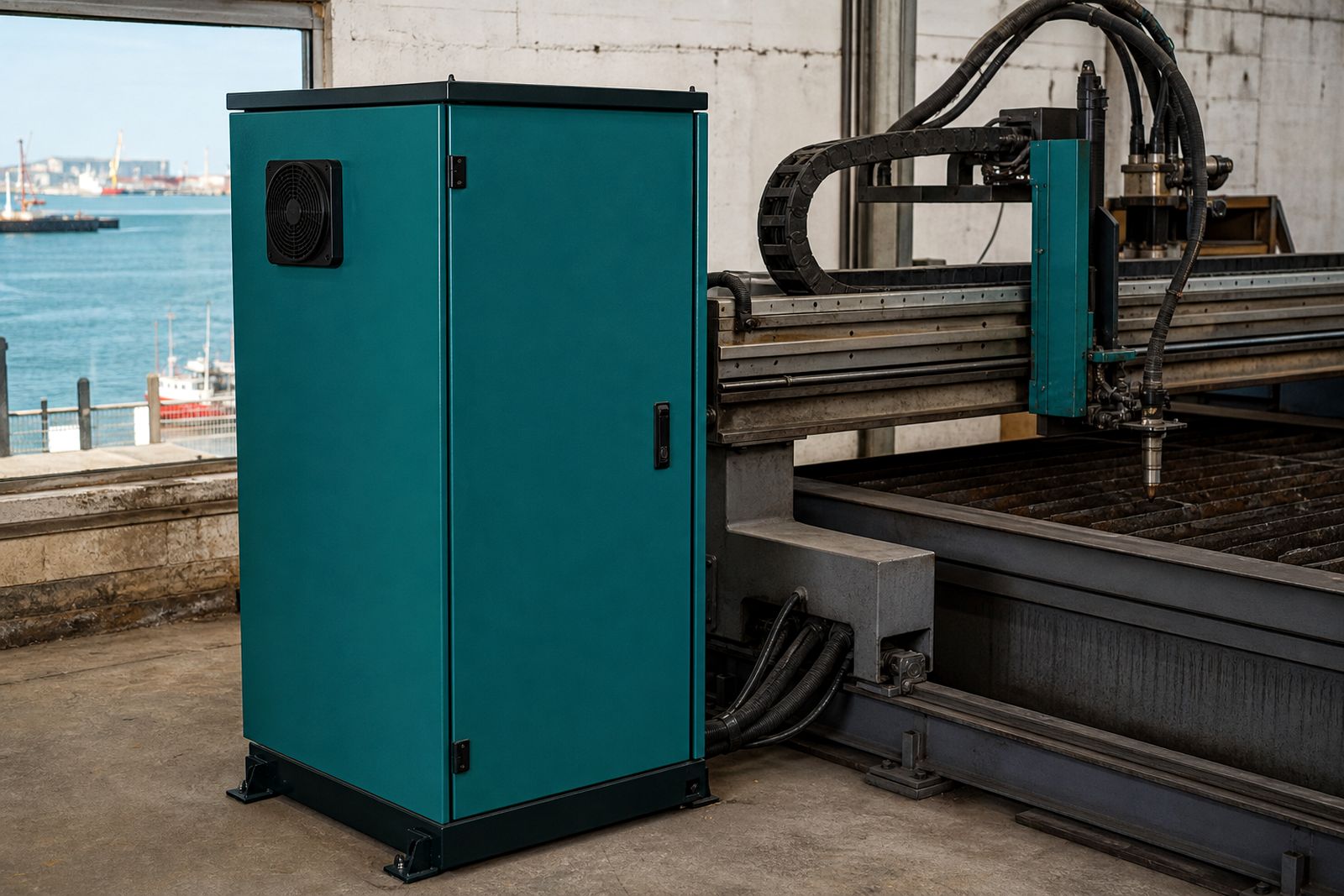
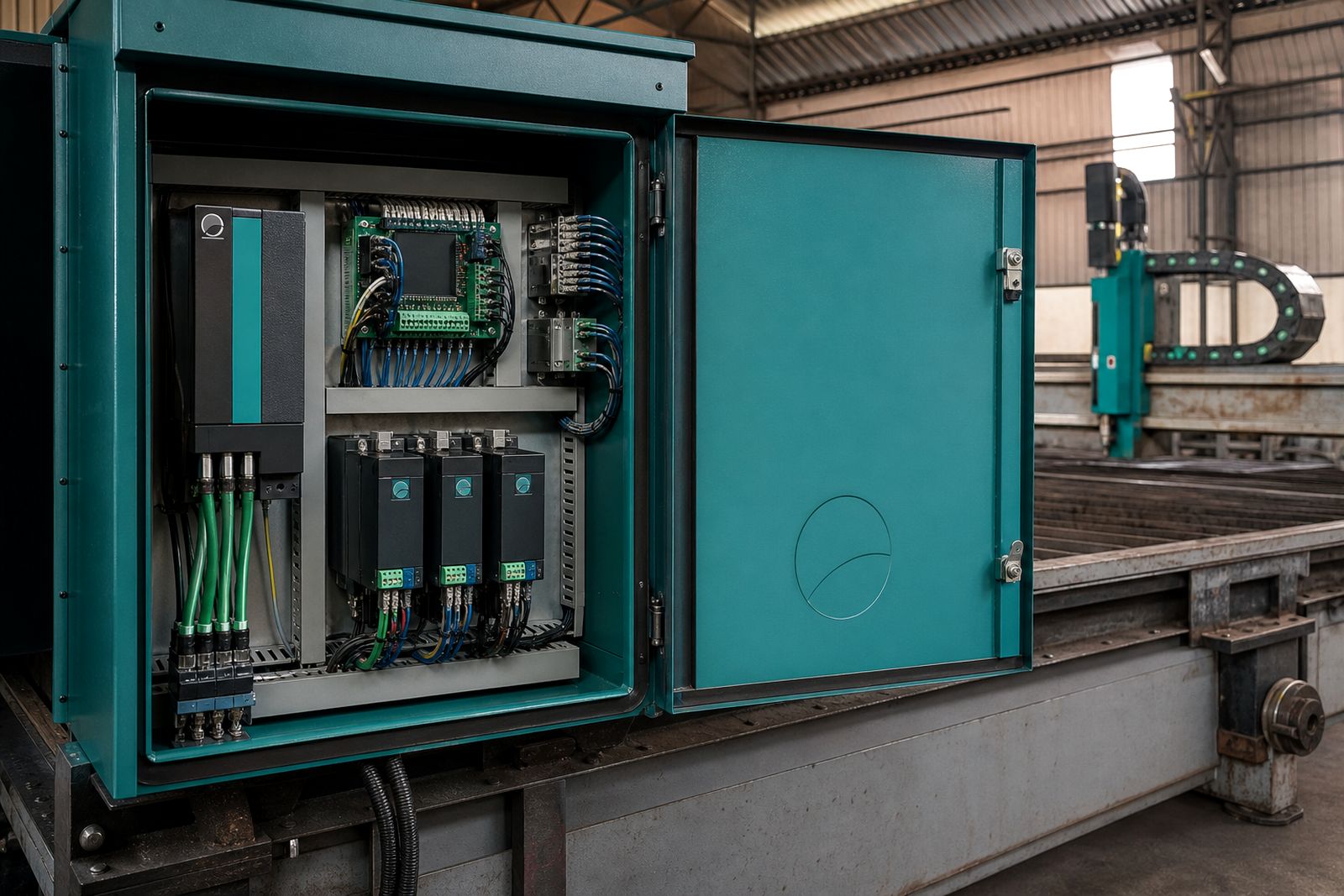
Many older tables reach the workshop log stage because the screen failed, but the real trouble sits lower down in the cabinet and on the gantry. Brittle drag-chain cable, oil-soaked connectors, loose earthing and tired motor feedback hardware all become more obvious once a modern controller is fitted. A retrofit should not inherit avoidable faults.
Plenty of existing drive hardware can stay in service if insulation tests, feedback quality and motion smoothness are still acceptable. Where the motors are mismatched, undersized or no longer stable at speed, we say so plainly. There is no point fitting a capable controller onto a table that still stalls under acceleration.
- Inspect drag chains for broken links and packed dross.
- Check motor mounts and gearbox play.
- Open junction boxes and look for green corrosion on terminals.
- Confirm earthing paths are clean and properly bonded.
- Test home switches, limit switches and cable flex under movement.
Coastal humidity matters here. Salt air gets into cabinets, plugs and shield terminations, then the machine develops odd intermittent faults that waste hours. If the table lives near the sea, cabinet sealing and airflow deserve proper attention, not a patch.
When the numbers favour a retrofit
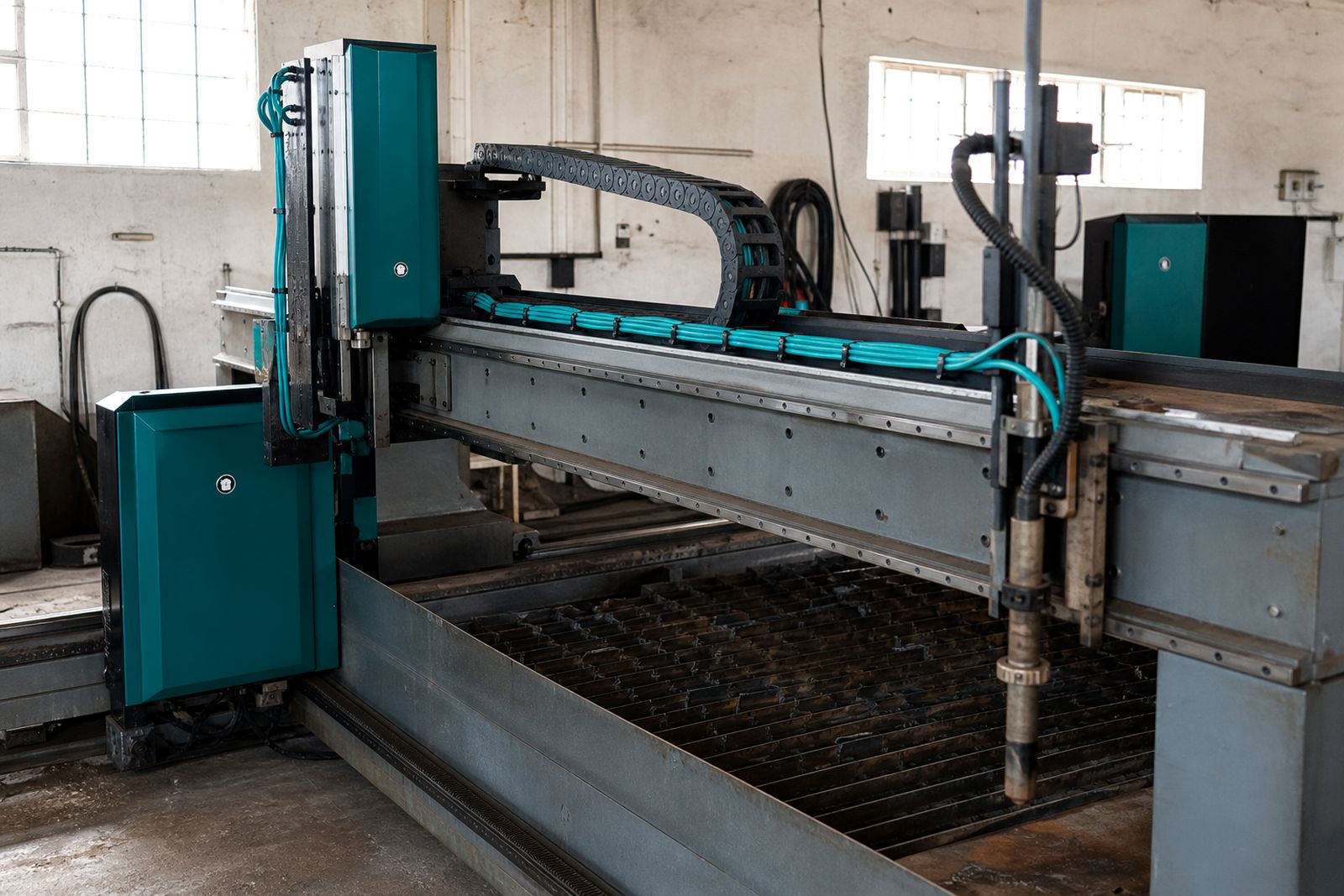
A table is usually worth retrofitting when the main steelwork is straight. The gantry must be able to be squared, the rail base must be recoverable, and the bed must be repairable without rebuilding the entire machine. In that case, new controls, torch-height control, nesting and CAM software, power-source pairing and extraction improvements can move production on sharply. You keep the usable mechanical platform and replace the parts that are holding back cut speed and cut finish.
It is usually a poor candidate when the frame is cracked in several areas. Rails may have no reliable datum left, the gantry may be twisted beyond practical correction, and the bed section may have been burnt away over a large area. At that point the labour and fabrication bill starts chasing the cost of a different route, and it is better to say so early. Frankly some tables are only worth stripping for a few salvageable items.
For shops in Kariega, East London, Makhanda and farther afield, photos help as a first pass, but a proper call is made from measurements and inspection on the machine itself. A retrofit decision should rest on the structure first, then motion, then controls.
A useful site visit starts with these details
If you want us to assess an existing table, gather a few practical details before sending it through our contact form. Clear dimensions and fault notes save a lot of guessing, and they help separate a controller problem from a structure problem. Even a phone snapshot of the rail line, bed and cabinet interior can show where the real spend is likely to land.
- Table cutting area in millimetres or metres.
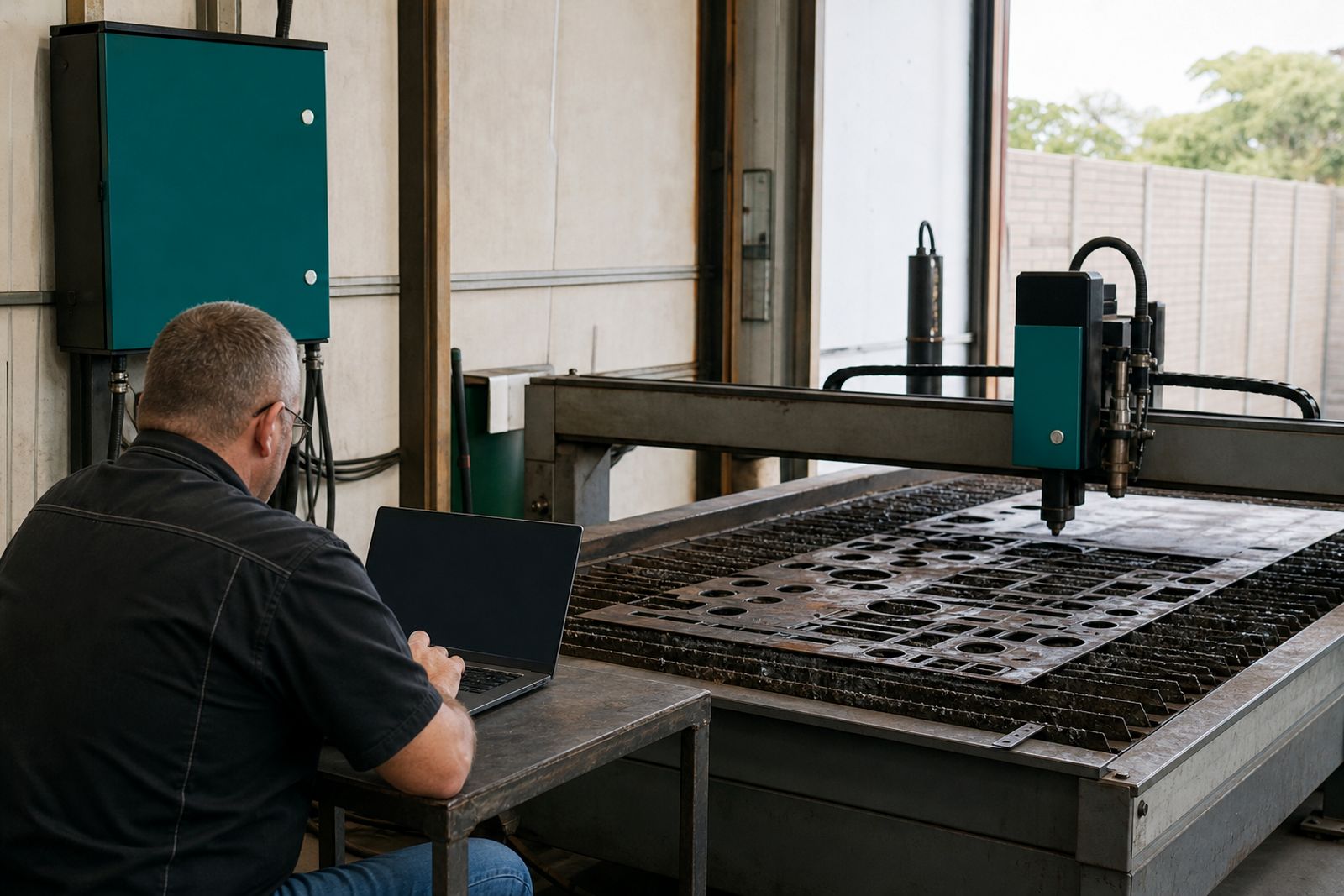
- Photo of the full table from both long sides.
- Close photos of rails, rack, pinions and slat bed.
- Cabinet interior photo with drives and wiring visible.
- Short note on the present fault, such as lost position, rough motion or unstable height.
- Your town and whether the table is in a coastal workshop or inland.
We retrofit existing plasma tables only, not complete new machines, replacement beds sold on their own or used machines. If the structure is sound there is often plenty to work with, and if it is poor we will say that plainly before you sink money into the wrong end of the job.
Questions we get asked
Can an old table cut well after a retrofit?
An old table can cut well after a retrofit if the frame, rails and gantry geometry are still serviceable. Better controls and height control help a lot, but only when the mechanical base can repeat movement properly.
Do you retrofit tables outside Gqeberha?
We cover Gqeberha and the Eastern Cape regularly, and retrofit crews travel to the Western Cape, Free State and Gauteng for suitable jobs.
Do you sell complete new plasma tables or used machines?
Our work is focused on retrofits, controls, height control, software, power-source pairing and extraction for existing tables.
Also worth a look
Tell us about the job
Send sizes, materials and where you are through our contact form, and we will come back with the practical options.
Open the contact form