

Salt air and control cabinets
Sea air can start trouble inside a plasma cabinet without any direct spray path. In Gqeberha workshops we often find corrosion starting from fine salt carried in through cable entries, fan openings and doors that look shut but are not sealing properly.
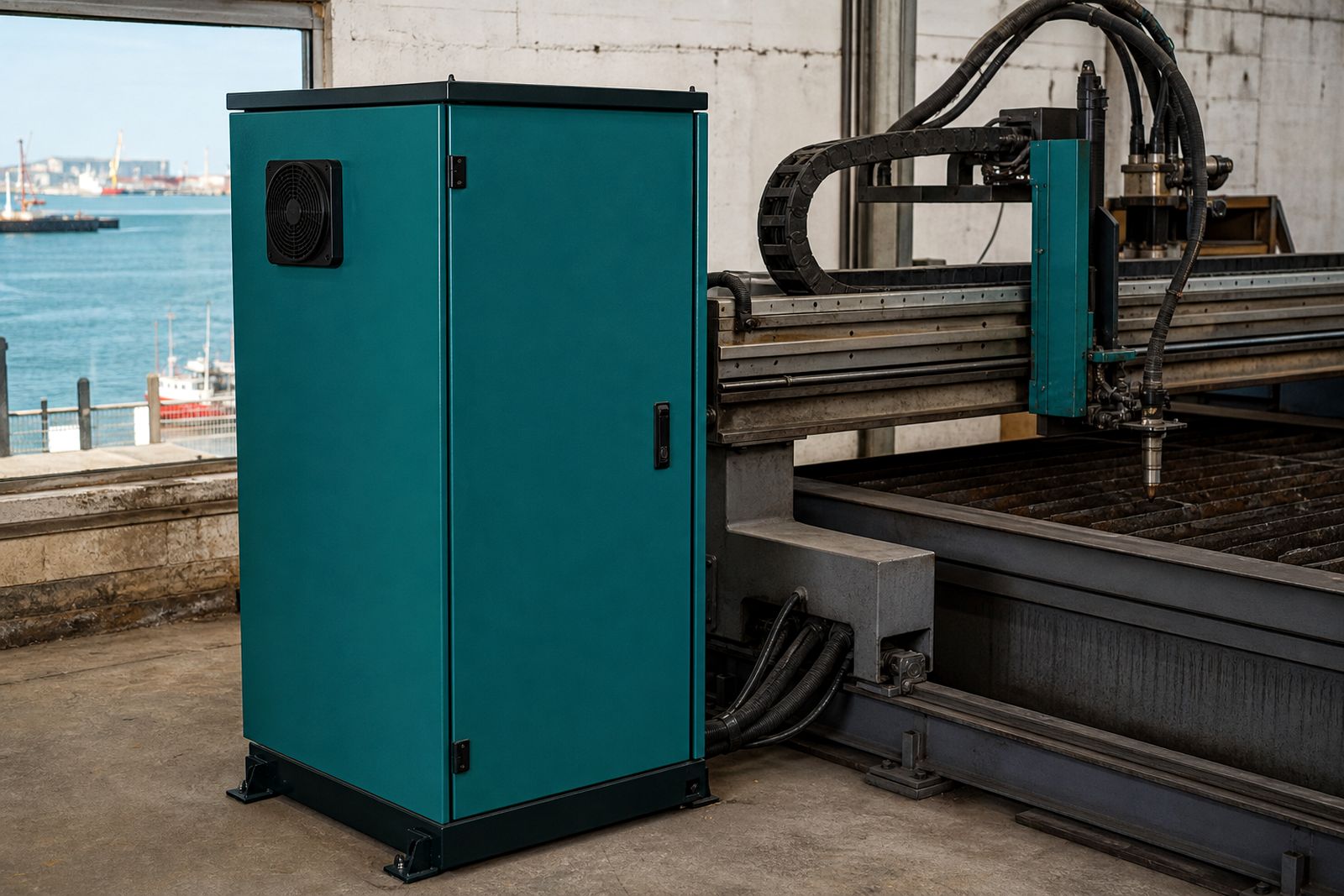
Salt gets in long before rust is obvious
Many table owners picture corrosion as a wet, dripping problem. In Nelson Mandela Bay it is usually finer than that. Salt sits in the air, settles on steelwork, and travels with every pressure change when a cabinet fan starts, a roller door opens, or a warm enclosure cools down after shift. The cabinet can look clean from the front while the lower cable zone, DIN rail screws and terminal edges are already showing the first white or brown bloom.
Plasma cutting adds another layer. Fine metallic dust mixes with coastal moisture and becomes slightly conductive. That is when odd faults start: a height control reading that wanders, limit inputs flickering, a controller reboot after a humid morning, or intermittent communication between the motion system and the power source. None of those faults are dramatic at first which is why the problem often runs for months before anyone opens the panel and sees what is really happening.
The entry points we check first on Eastern Cape tables
On a coastal retrofit we do not begin with software settings. We start by looking at how the enclosure breathes and where it leaks. Even small openings can pull salty air into a cabinet. A few small gaps in the wrong places are enough especially when the workshop has a cross-breeze from open doors facing the bay.
- Door seals that have gone flat or hardened, especially on older enclosures near ovens, compressors or direct sun.
- Cable glands that were drilled oversized and packed with silicone instead of using the right gland size.
- Unused holes from earlier controls, pendant arms or add-on relays left with thin plastic blanks.
- Cooling fans mounted low on the cabinet where they draw floor dust and damp air straight across the electronics.
- Top vents without proper filtered covers, letting salty air settle onto power supplies and drive terminals.
- Loose gland plates at the cabinet base where motion cables and torch leads pass through together.
In Gqeberha and Kariega we see another local pattern. Workshops close to busy roads have fine grit working with the salt. It scours fan filters and leaves tiny gaps around doors and hinges, then the sea air follows that path. It sounds minor but it shows up quickly on exposed terminal screws.
A workshop example from the bay
One gantry table near the harbour had a control cabinet mounted against a wall that never saw direct rain. The operator assumed the panel was safe because the shop floor stayed dry. Cut quality had slowly slipped though, with torch height drifting on thinner plate and random stop faults on longer nests. When we opened the cabinet we found a chain of small coastal issues.
The lower gland plate had been opened several times over the years and no longer clamped evenly. A fan on the side panel was running without an effective filter pad. The inside of the door carried a faint salt film you could feel with a fingertip. Several low-voltage terminals had early corrosion and one earthing point showed discolouration. Nothing looked catastrophic, yet the signals were no longer clean and the enclosure was breathing workshop air every time the fan started.
That table did not need a new machine, and it did not need guesswork. The cure was sealing, rerouting, replacing affected small parts, and setting the cabinet up so airflow and cable entry made sense for a coastal site. After that, cut height settled down and nuisance trips stopped. It was a plain workshop fix not magic.
How we seal a cabinet without cooking the electronics
Sealing a control cabinet is not the same as blocking every hole. Drives, power supplies and motion controls still have to lose heat. The job is to control where air enters, where it leaves and what gets filtered on the way. A badly sealed panel can run hotter than it should while still pulling salt in through the easiest gap.
- We replace tired door gaskets and check latch pressure so the seal is even on all four sides.
- We correct cable entry with proper glands and blanking hardware rather than relying on mastic alone.
- We move or resize fans where needed so airflow is deliberate and suited to the cabinet layout.
- We fit suitable filtration on intake points and avoid layouts that drag floor dust across control boards.
- We separate high-noise cable runs from sensitive signal wiring where the old panel has everything bundled together.
- We inspect earthing and bonding because corrosion at those points can cause strange behaviour long before failure.
On some tables we also change cabinet placement or add a simple shroud if the enclosure sits in a direct path between a roller door and the cutting area. That small change can reduce the daily salt load quite a bit. Every site is different and some older panels need a bit of rework before the sealing details hold properly.
Cabinet habits that help on the coast
A sealed retrofit will last longer if the workshop routine supports it. Coastal corrosion is cumulative. Once a cabinet starts collecting residue, every humid spell adds another fine layer. A short planned inspection beats an emergency stop in the middle of a production run.
- Keep cabinet doors shut during cutting, even when operators want to watch indicator lights.
- Change filter media before it collapses or bypasses around the frame.
- Do not store offcuts, rags or consumable boxes against the cabinet base where they trap damp air.
- Check door seals after any electrical work because one pinched section is enough to break the seal.
- Look for white deposits on screws, gland threads and earth studs, those are early warnings.
- Schedule internal cleaning with the right method rather than blowing dust deeper into the panel.
We also tell shops not to ignore the area around the cabinet. If extraction is poor and smoke lingers, the cabinet becomes a dust collector. Good fume control helps the electronics indirectly because less particulate is available to mix with coastal moisture.
When a retrofit should include cabinet work
If you are swapping controllers, adding torch-height control, pairing a different power source or rebuilding motion hardware, that is the right time to sort out the enclosure. New control gear installed into a compromised cabinet inherits the same air path, the same contamination and the same weak cable entry. The hardware may be better, but the environment is still wrong.
On Eastern Cape sites we often fold cabinet sealing into a broader retrofit so the table leaves with cleaner wiring, better component layout and a more controlled airflow path. That matters in Makhanda and East London as much as Gqeberha, and it matters even more on tables that stand in workshops less than a few kilometres from the coast. If your table is showing odd electrical faults, or if the cabinet door leaves a salt mark on your hand, it is worth having the enclosure checked alongside the controls.
For retrofit assessments and cabinet sealing work on existing plasma tables, use our contact form.
Questions we get asked
Can a cabinet be too sealed for plasma controls?
A cabinet can be sealed too tightly if heat cannot escape, because drives and power supplies then run hotter and service life drops. Controlled intake and exhaust with proper filtration keep the balance right.
Does inland dust matter as much as sea air?
It causes different trouble. Dust on its own is bad enough, but on the coast it mixes with moisture and salt and becomes more likely to create tracking, corrosion and unstable low-voltage signals.
Should we replace the whole table if the cabinet is corroded?
Not always. Many older tables can be kept productive with cabinet repairs, control retrofits, wiring cleanup and better airflow management. The condition of the structure, motion parts and power setup still needs to be checked first.
Also worth a look
Tell us about the job
Send sizes, materials and where you are through our contact form, and we will come back with the practical options.
Open the contact form